

You did what felt right. You googled it. You asked someone you trust. You went over it one more time in your head, just to make sure. And for a moment, a few minutes, maybe longer, the anxiety lifted.
Then it came back.
If this sounds familiar, you are not doing anxiety wrong. You are doing exactly what anxiety is designed to make you do. The problem is that what feels like relief is actually what keeps the cycle going.
The anxiety loop — and what breaks it
Anxiety is, at its core, a threat detection system. Your brain picks up on something uncertain or uncomfortable, a physical sensation, a thought, a situation, and it sounds the alarm. That alarm produces a feeling we recognise as anxiety: the tightening, the racing thoughts, the urgent need to do something.
So you do something. You check. You avoid. You Google. You ask for reassurance. You replay the situation. And it works — anxiety comes down. Your nervous system exhales.
Here is what is happening underneath that: the temporary relief is real, but it teaches your brain something it was not supposed to learn. That the threat was real, and that what you just did is how you handle it. So the next time anxiety spikes, the urge to check, avoid, or reassure comes back stronger. The threshold gets lower. The cycle speeds up.
This is the trap. Not a character flaw. Not a thinking problem. A learning loop that your brain is running exactly as designed.
The diagram below shows how that loop runs, and where it can be interrupted.
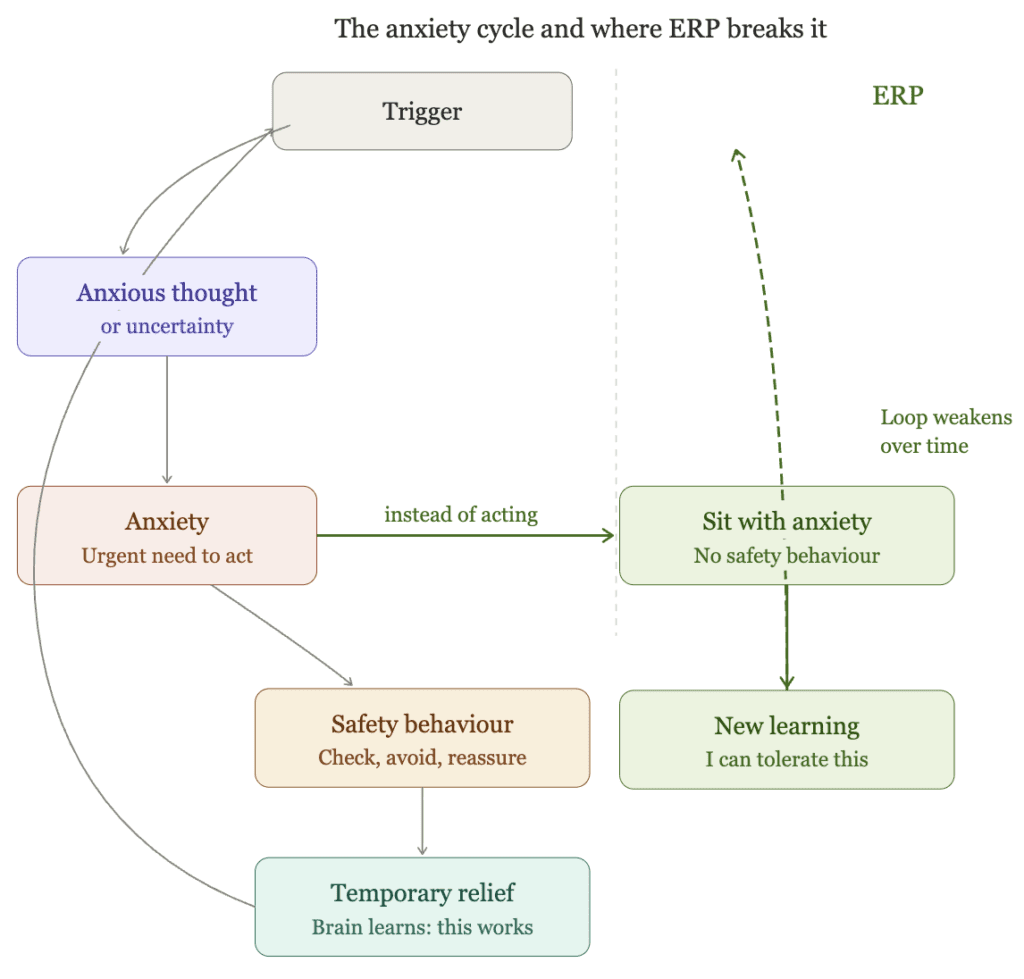
The left side is the trap. The right side is what Exposure and Response Prevention (ERP) does differently: instead of following anxiety into the safety behaviour, you sit with the discomfort without acting on it. Your brain does not get the signal that the threat was real. Over time and with repetition, it starts to learn something new: that the feeling is tolerable, and that the safety behaviour was not what was keeping you safe. The loop weakens.
What counts as a safety behaviour?
Safety behaviours are anything done to reduce anxiety in the moment. That sounds simple, but in practice the line can feel blurry. Is it wrong to Google a health worry? To ask a friend for their take? To leave a situation that is overwhelming you?
Not necessarily. Here is the question that actually matters: what is the function of what you are doing?
The same behaviour can be genuinely useful or anxiety-maintaining, depending on why you are doing it. Researching a medical symptom because you are preparing for a doctor’s appointment is different from researching it because you cannot tolerate not knowing right now. Asking a trusted person for their perspective is different from asking them to confirm what you already know so you can stop feeling anxious.
Some common safety behaviours and what they often look like in practice:
Reassurance-seeking. Asking someone “do you think I’m okay?” and needing to ask again a few days later because the relief did not hold.
Checking. Going back to re-read a sent email to make sure you did not say anything offensive. Checking locks, appliances, or your body for signs of something wrong.
Avoidance. Skipping situations that might trigger anxiety. This includes subtle avoidance: sitting near the exit, not making eye contact, having a drink before the event.
Researching. Googling symptoms, worst-case scenarios, or “how to know if you have X,” not for information, but to make the uncertainty quieter.
Mental rehearsal and rumination. Going over a future situation to prepare for every outcome, or replaying a past one to figure out where it went wrong.
None of these are inherently problematic. They become a red flag when their function is anxiety reduction, because the short-term relief teaches your brain to keep doing them.
The question is not what you are doing. It is why. If the honest answer is “to make the feeling stop,” that is worth paying attention to.
Where the anxiety spectrum matters
This loop runs at different intensities for different people.
For many, it shows up as garden-variety anxiety: overthinking, reassurance-seeking, avoiding things that feel risky. The loop is uncomfortable and exhausting, but relatively manageable day-to-day.
At the more intense end of the spectrum, particularly in OCD and related conditions, the loop becomes highly structured. Specific triggers produce specific intrusive thoughts, often distressing and unwanted, which produce intense anxiety, which produce compulsions: ritualized behaviours or mental acts that bring the anxiety down fast. The relief is immediate, powerful, and short-lived. The compulsions become harder to resist over time.
Whether the loop is mild or severe, the underlying mechanism is the same. What changes is the intensity, the speed, and how much it takes over daily life.
What ERP involves
The “prevention” part of Exposure and Response Prevention is what makes it different from simply facing your fears. Facing the trigger but still checking, reassuring, or avoiding at the end puts you back in the same loop. ERP specifically targets the point where the loop gets reinforced, the safety behaviour, and interrupts it there.
What happens when you sit with anxiety without doing the thing that brings relief? Initially, it is genuinely uncomfortable. But with time and repetition, your brain starts to learn something different: that the threat was not what it seemed, that the feeling is survivable, and that the safety behaviour was not what was keeping you safe.
This work is done gradually, collaboratively, and paced to what you can actually manage. It is challenging, and it is also one of the more reliably effective things we know how to do for anxiety.
If you recognise this loop in your own patterns, whether anxiety is making your days harder or it has become something more structured and consuming, therapy can help you understand what is keeping it going and start stepping out of it. Learn more about anxiety therapy here and book your free consultation to get started.


